Guide: Translation
MOJ Certified Translation Dubai: What It Means and When You Need It
MOJ certified translation Dubai means a translation done by a legal translator registered with the UAE Ministry of Justice, for use with an official body. When your document needs a notary, our in-house notary public notarises it in person, online or at your home. We handle the translation and the notary step together.
WhatsApp +971 52 947 5935 with a photo of your document.
Many people ordering MOJ certified translation Dubai services think the translation alone is enough. It often is not. Courts, ministries, banks and embassies each decide what they accept, so check with the office that asked for the document before you pay for anything.
What MOJ Certified Translation Means
This is the work behind “moj certified legal translation Dubai”: a translator who is registered with the UAE Ministry of Justice and who translates a document for official use.
The translator does the translation. The translator does not check your identity, and does not witness your signature. That is the job of a notary public, who is a separate role. A private notary in Dubai is a lawyer licensed by Dubai Courts to carry out notarial acts.
So a certified translation answers “is the text in the other language correct?” and a notarisation answers “who signed this, and did they sign in front of a notary?”
When a UAE Office Asks for It
A UAE office usually asks for an MOJ certified translation Dubai residents can use when your document is in a language it cannot process. Typical cases:
- A foreign certificate, contract or court paper that must be read in Arabic.
- A power of attorney drafted in one language and used with an office that works in the other.
- Company papers, family papers or school records for a government file.
Each office has its own rule. Ask it three questions: which language does it need, does it want a certified translation, and does it also want notarisation. Our page on legal translation for notarisation in Dubai covers the notary side in more detail.
Certified Translation for Use Abroad
For a UAE document going abroad, the usual order is: translation if needed, our notary step, then attestation. The UAE is not a party to the Hague Apostille Convention, so an apostille does not replace the chain.
MOFAIC attests documents in the UAE. The next stop is the destination country’s embassy or consulate in the UAE. MOFAIC fees are AED 150 for personal documents and AED 2,000 for commercial documents, paid on top, at cost.
A foreign document coming into the UAE goes the other way. It is attested in the issuing country, including the UAE embassy there, and then by MOFAIC in the UAE. See MOFA attestation in Dubai and embassy attestation in Dubai.
The office abroad that receives the document decides what it accepts. Ask it first.

Send us your document
Send a photo of your document and the name of the office that asked for it. We reply with the route and a written quote.
Step by step
Translation and Notarisation Together
A certified translation is not the same as a notarised translation. The first is the translator’s work. The second adds our notary step on top.

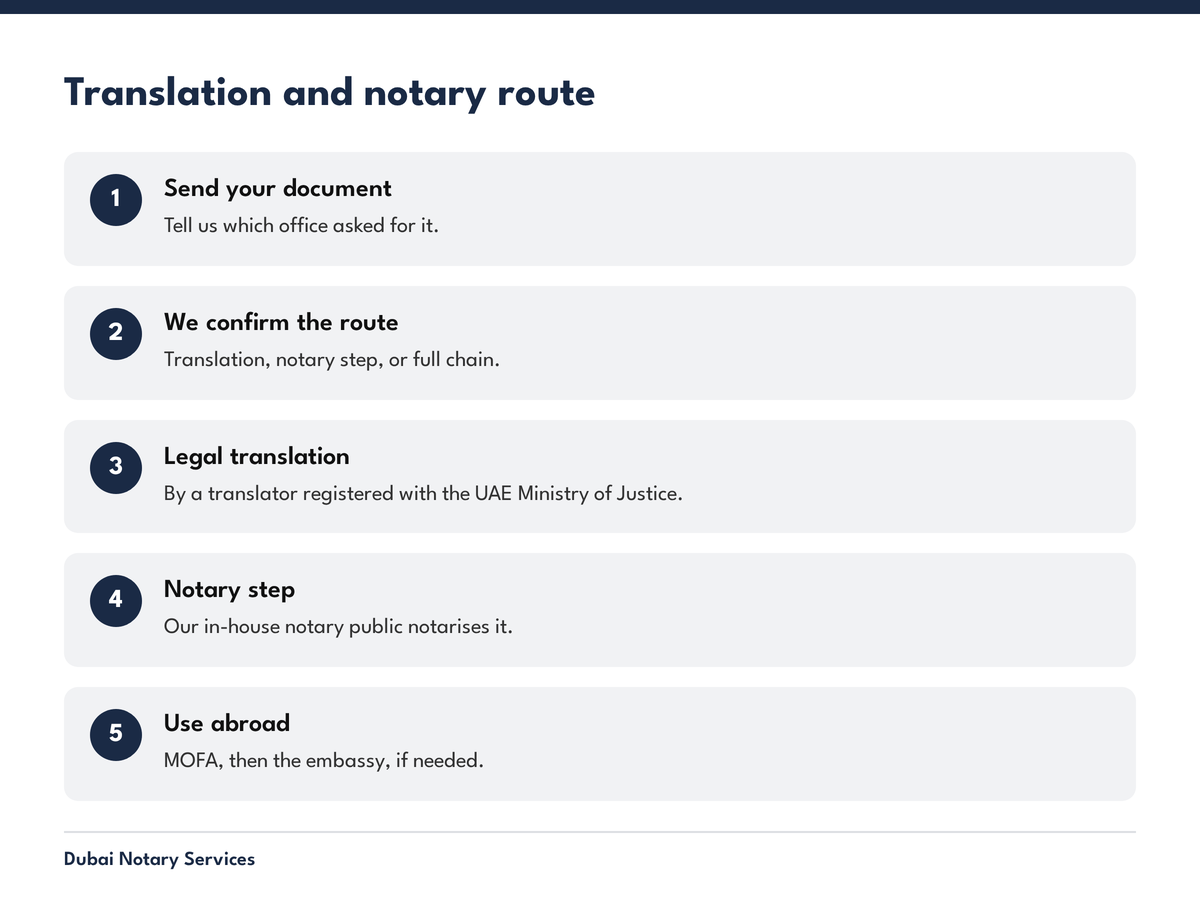
01
You send us the document and tell us which office asked for it.
02
We tell you the route: translation only, translation and notary, or the full chain for use abroad.
03
The legal translation is done by a legal translator registered with the UAE Ministry of Justice.
04
Our in-house notary public checks identity, witnesses the signing and notarises, where the document needs it.
05
If the document is going abroad, we take it through MOFA and the embassy.
You can come to us, sign online by video, or ask for a home visit. We tell you if your document can be done online. For online signing, see online notary in the UAE. Home visit cost is quoted when you book.
Checklist
What to Bring
- The original document, or a clear photo to start.
- Your passport or Emirates ID.
- The name of the office that asked for the translation.
- The language the receiving office needs.
- Any earlier attestation stamps, if the document came from abroad.
Watch for
Mistakes to Avoid
- Paying for a translation before asking the receiving office what it accepts.
- Translating a document that is only a photocopy, when the office wants a certified copy first. We can certify a true copy first.
- Signing a power of attorney before the translation is final.
- Sending a document for attestation before the notary step.
- Assuming a translation also counts as attestation.
How We Help
We draft your document, our in-house notary public notarises it, and we take it through MOFA and the embassy when it has to be used abroad. The translation itself is done by a legal translator registered with the UAE Ministry of Justice, and we include it in your file. For a notarised power of attorney, see power of attorney notarisation in Dubai.
Prices
Prices
| Service | Our service price | Government fee, paid on top at cost |
|---|---|---|
| Legal translation | from AED 50 per page | none for the translation itself |
| Power of attorney of any type | from AED 1,500 | notary fee of AED 100 per party for a power of attorney, under Cabinet Resolution No. 19 of 2024 |
| Certified true copy | from AED 400 | as charged by the authority |
| MOFA attestation handling, personal document | from AED 150 | MOFAIC AED 150 |
Questions
Frequently asked questions
What is an MOJ certified translation?
It is a translation made for official use by a legal translator registered with the UAE Ministry of Justice. The receiving office decides whether it also needs notarisation or attestation.
Does the translation need to be in Arabic?
Not always. It depends on the office that receives the document. Ask it which language it needs, then send us the document and we tell you the route.
Who is a Ministry of Justice certified translator?
The role belongs to a legal translator registered with the UAE Ministry of Justice. The translator translates your text. A notary public, who is a lawyer licensed by Dubai Courts if private, checks identity and witnesses signing, which is a different job.
Do I need an MOJ certified legal translation in Dubai?
You need one when an official body asks for a document in a language it cannot process. Courts, ministries and banks differ, so ask the office first. Then send us the document and we tell you the route.
Is a certified translation the same as a notarised translation?
No. A certified translation is the translator’s work. A notarised translation adds a notary step. Some offices want only the first, some want both, and some want attestation as well.
Guides
More guides

Certificates
Degree equivalency
An MOE equivalency certificate in UAE is the name many people use for an official decision on what a foreign qualification is equal to in the UAE system.


Notary and MOFA
MOFA verification
MOFA attestation verification is the check an employer, school, bank or government office makes to confirm that the MOFA attestation on a document is real and belongs to.
Send Us Your Document
Call or WhatsApp +971 52 947 5935, or email info@dubainotaryservices.com, with a photo of your document and the name of the office that asked for it. We reply with the route and a written quote. Office open Monday to Friday, 9:00 am to 6:00 pm. WhatsApp and online requests answered 24/7.